
India's Polar Satellite Launch vehicle-C16 rocket on Wednesday successfully launched into orbit the latest remote sensing satellite Resourcesat-2 that would study and help manage natural resources along with two nano satellites.
India's ambitious Mars Orbiter Mission will send a spacecraft hurtling into space on a 400-million-kilometre journey that will last a year. The blast off is on Tuesday afternoon.

Dravida Munnetra Kazhagam (DMK) leader and Fisheries Minister Anitha Radhakrishnan accepted the mistake on Thursday after the Tamil Nadu government was left red-faced after an advertisement for a new Indian Space Research Organisation (ISRO) that featured a rocket with the flag of China.
In an exclusive commercial launch to be witnessed by Prime Minister Narendra Modi, India's national space agency ISRO is set to launch five satellites from four countries from the spaceport of Sriharikota.
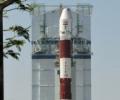
Indo-French oceanographic study satellite 'SARAL' and six foreign mini and micro spacecrafts were successfully launched on Monday by Indian Space Research Organisation's PSLV-C20 rocket from this spaceport.

On Sunday morning, in its mission to place an earth observation satellite and students satellite into the low earth orbit, the SSLV-D1/EOS-02 blasted off precisely at 9.18 am amid cloudy skies from the first launch pad at Satish Dhawan Space Centre in this spaceport.
Indian Space Research Organisation is all set for the launch of the first flight-testing of indigenous cryogenic engine on homespun rocket, Geosynchronous Satellite Launch Vehicle (GSLV-D3), from the Satish Dhawan Space Centre at Sriharikota at 4.27 pm on Thursday.
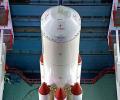
India on Friday successfully launched its latest communication satellite GSAT-12 onboard a powerful variant of homegrown Polar Satellite Launch Vehicle, PSLV-C17, from the spaceport in Sriharikota.

Around 23 minutes after lift-off, the primary satellite got separated and it was followed by six other co-passenger satellites, which were deployed into the intended orbits sequentially, ISRO said.
It is scheduled for lift-off at 1658 IST on Thursday from the space port at Satish Dhawan Space Centre at Sriharikota, about 100 km from Chennai.
The final 52-hour countdown for the October 22 launch of the country's first moon mission, Chandrayaan-I, began early on Monday morning at the Satish Dhawan Space Centre at Sriharikota in Andhra Pradesh.

The Indian Space Research Organisation (ISRO) successfully launched its third and final developmental flight of Small Satellite Launch Vehicle here on Friday whose payloads can be used in applications like satellite-based surveillance, disaster and environmental monitoring, fire detection, volcanic activity among others.

Scientists are working on conducting various tests for the ambitious Gaganyaan mission and the agency is coordinating with the Navy and others in this connection, he said.
"It will take about five-and-half days for Chandrayaan-1 to get to the moon," officials said, adding that the probe will be in a 100 km polar orbit around the Moon.
Following are some interesting facts about the 1,350-kg 'Mangalyaan' mission and its launch

The 1,858 kg spacecraft, the country's first microwave remote sensing satellite, was injected into orbit by the Polar Satellite Launch Vehicle about 19 minutes after a perfect lift off at 5.47 am at the end of the 71-hour countdown from the Satish Dhawan Space Centre, around 90 km from Chennai.
It is raining heavily at Sriharikota where the Satish Dhawan Space Centre is located
The 44 metre tall four-stage PSLV placed Italian satellite AGILE into orbit at 550 km above the earth.
Delhi will be the first place to be mapped by Cartosat followed by Goa.
Launch of India's latest communication satellite GSAT-5P onboard homegrown GSLV-F06, powered by Russian cryogenic engine, failed on Saturday when the rocket developed a snag soon after lift-off from the spaceport in Sriharikota.
Roddam Narasimha, space scientist, says that one of the most important assignments during this mission, which cost over Rs 300 crore, would be to tap and see how useful the helium found on the moon would be.
India will join an elite group of nations with the launch of a new mission to test re-entry technology, which would be a forerunner to developing reusable vehicles like space shuttles.
Stage is set for the launch of PSLV-C9 from the Satish Dhawan Space Centre, Sriharikota. As many as ten satellites will be launched on Monday by the Indian Space Research Organisation, including country's latest remote sensing satellite and eight nano satellites.
ISRO's Polar Satellite Launch Vehicle-C6, carrying India's remote sensing satellite CARTOSAT-1 and a micro satellite HAMSAT, blasted off from the Satish Dhawan Space Centre in Sriharikota on Thursday.
The launch vehicle that lifted off from a newly built launchpad will release two satellites in the earth's orbit.
The ISRO will launch its ambitious and maiden mission to the moon, Chandrayaan-I, from the Satish Dhawan Space Centre at Sriharikota on April 9, 2008. "We are looking for a launch on April 9," Mylswamy Annadurai, head of Chandrayaan-I said.
The 44.5-metre-tall, 295-tonne PSLV-C7 lifted off from the launch pad at 9.24 am.
The PSLV-C8 rocket will make its first commercial launch with an Italian astronomical satellite on board.

EOS-01 is an earth observation satellite intended for applications in agriculture, forestry and disaster management support, ISRO has said.
The Polar Satellite Launch Vehicle is carrying 1360-kg satellite 'Resourcesat -I'.
Greet the scientists on achieving this major milestone!
INSAT-4CR is similar to INSAT-4C, which was lost during the unsuccessful launch last year.
This is the first time ISRO was putting into orbit a two-tonne class satellite.\n\n
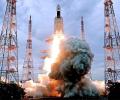
'You can observe a lot of things from space.' 'Another thing is communication, in real time, especially in war-like situations.' 'During Operation Sindoor, we could play our part well.'
The GSLV will put into orbit the INSAT-4CR, which carries 12 high-power Ku-band transponders for direct-to-home television services, video picture transmission and digital satellite news gathering.
India becomes the fifth country after United States, Russia, China and France to enter the launch market.
The Polar Satellite Launch Vehicle PSLV-C15 carrying five payloads, including India's remote sensing satellite Cartosat-2B, successfully lifted off from the spaceport in Sriharikota on Monday.
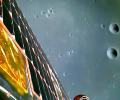
Taking to X (formerly Twitter), ISRO said, "Chandrayaan-3 Mission. Chandrayaan-3 Rover to MOX, ISTRAC, Moon walk begins!"

The two satellites that PSLV will release in the orbit will help the country's mapmakers and amateur radio operators.
